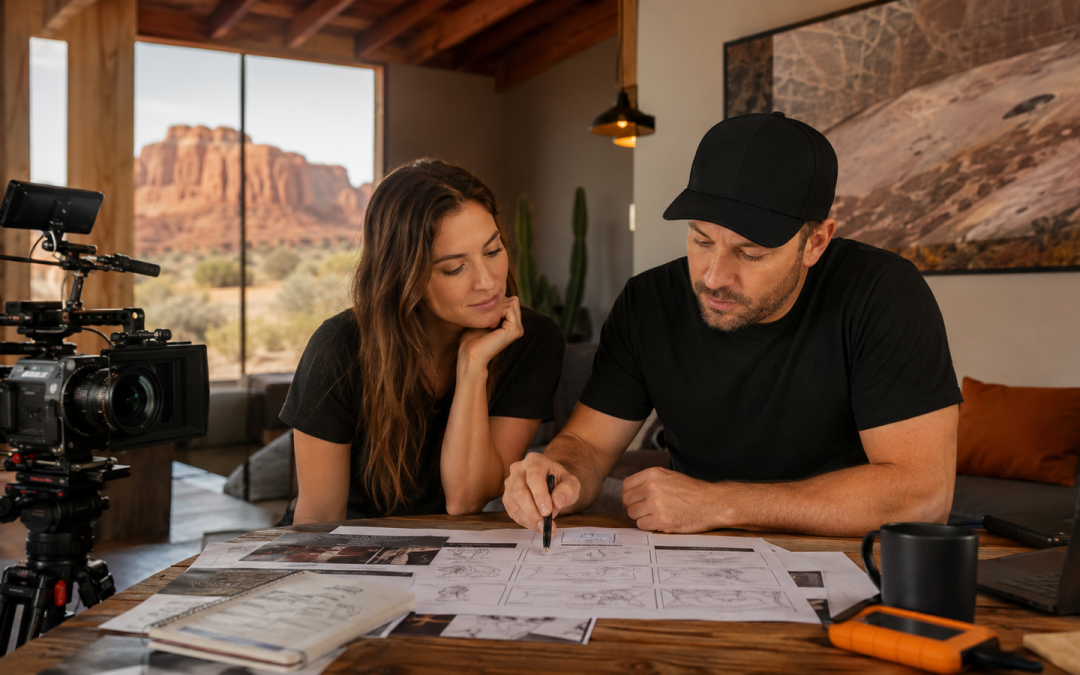
As the owner of EVDEO Creations, I start with a direct principle: define one audience, one problem, and one next action before production begins. A business video has to do more than look polished. It must help a defined audience understand something, trust something, or take a useful next step. Owner explains his audience-first planning process and how it prevents attractive videos from missing the sales goal. That is the perspective I bring to video marketing strategy Tucson projects. I look at the communication problem first, then build the production around the moments that carry meaning and proof. The following process explains how I approach the work and what a business owner should expect from a thoughtful production partner.
Start with the business decision
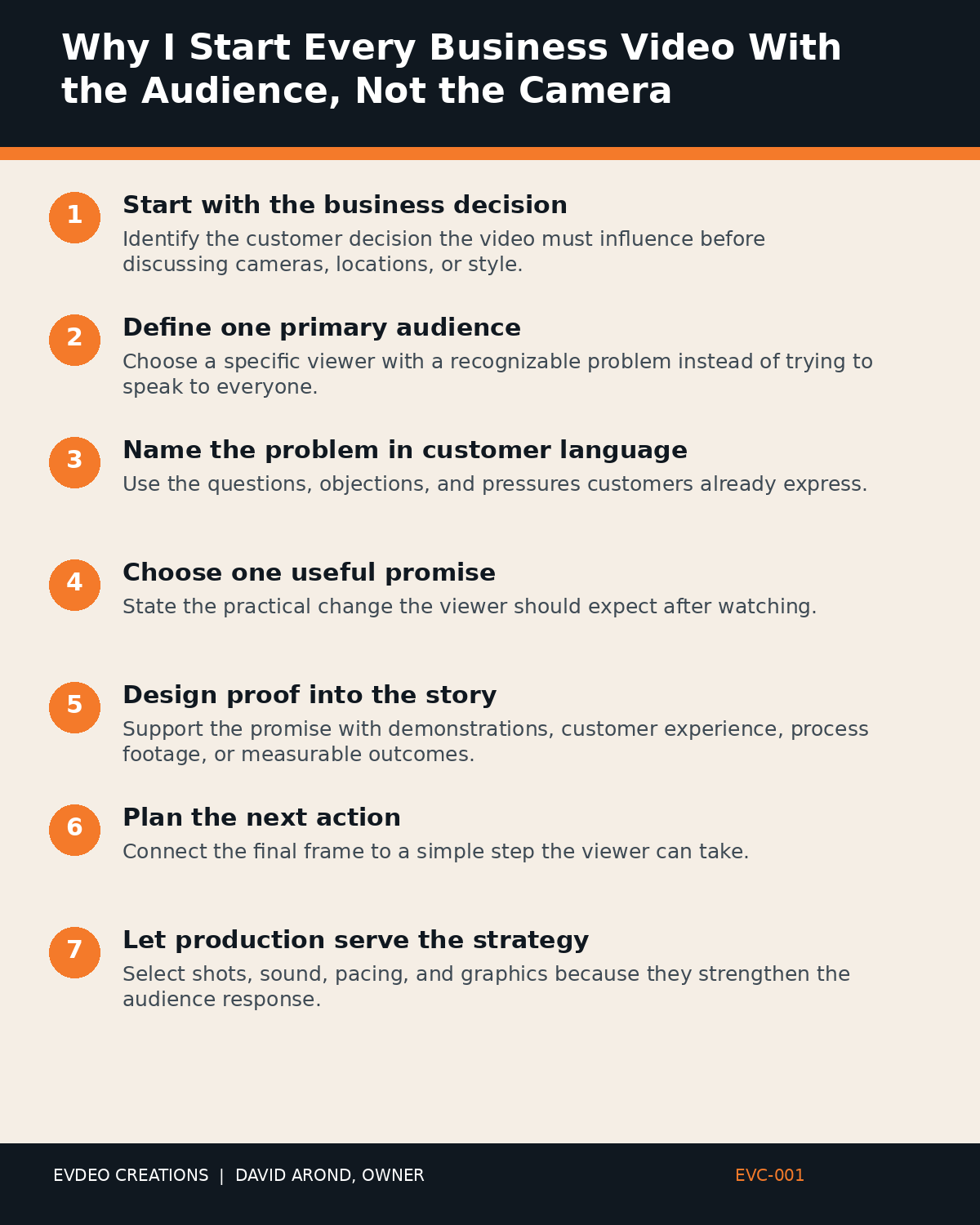
When I plan video marketing work, I begin with identify the customer decision the video must influence before discussing cameras, locations, or style. I want the client and production team to understand what success looks like before we spend time or budget. That shared definition gives us a way to evaluate ideas, locations, interviews, shots, graphics, and edits. It also prevents a familiar problem: adding material because it looks impressive even though it does not help the viewer understand, believe, or act. For a business considering video marketing strategy Tucson, I translate this principle into specific questions. What does the audience already know? What uncertainty blocks the next step? What evidence would feel credible? What should the viewer remember a day later? The answers become creative boundaries. Boundaries do not reduce creativity; they give the creative work a direction and a standard. My recommendation is to document this decision in plain language and use it during every review. If a proposed element strengthens the audience experience, we keep developing it. If it distracts from the central idea, we simplify it. That discipline usually improves the finished video and makes approvals faster because everyone is judging the same objective.
Define one primary audience
This part of the process often determines whether why i start every business video with the audience, not the camera becomes useful business communication or only attractive footage. I want the client and production team to understand what success looks like before we spend time or budget. That shared definition gives us a way to evaluate ideas, locations, interviews, shots, graphics, and edits. It also prevents a familiar problem: adding material because it looks impressive even though it does not help the viewer understand, believe, or act. For a business considering video marketing strategy Tucson, I translate this principle into specific questions. What does the audience already know? What uncertainty blocks the next step? What evidence would feel credible? What should the viewer remember a day later? The answers become creative boundaries. Boundaries do not reduce creativity; they give the creative work a direction and a standard. My recommendation is to document this decision in plain language and use it during every review. If a proposed element strengthens the audience experience, we keep developing it. If it distracts from the central idea, we simplify it. That discipline usually improves the finished video and makes approvals faster because everyone is judging the same objective.
Name the problem in customer language
In practical terms, use the questions, objections, and pressures customers already express. I want the client and production team to understand what success looks like before we spend time or budget. That shared definition gives us a way to evaluate ideas, locations, interviews, shots, graphics, and edits. It also prevents a familiar problem: adding material because it looks impressive even though it does not help the viewer understand, believe, or act. For a business considering video marketing strategy Tucson, I translate this principle into specific questions. What does the audience already know? What uncertainty blocks the next step? What evidence would feel credible? What should the viewer remember a day later? The answers become creative boundaries. Boundaries do not reduce creativity; they give the creative work a direction and a standard. My recommendation is to document this decision in plain language and use it during every review. If a proposed element strengthens the audience experience, we keep developing it. If it distracts from the central idea, we simplify it. That discipline usually improves the finished video and makes approvals faster because everyone is judging the same objective.
Choose one useful promise
I have learned to treat this as a production decision and a marketing decision at the same time. I want the client and production team to understand what success looks like before we spend time or budget. That shared definition gives us a way to evaluate ideas, locations, interviews, shots, graphics, and edits. It also prevents a familiar problem: adding material because it looks impressive even though it does not help the viewer understand, believe, or act. For a business considering video marketing strategy Tucson, I translate this principle into specific questions. What does the audience already know? What uncertainty blocks the next step? What evidence would feel credible? What should the viewer remember a day later? The answers become creative boundaries. Boundaries do not reduce creativity; they give the creative work a direction and a standard. My recommendation is to document this decision in plain language and use it during every review. If a proposed element strengthens the audience experience, we keep developing it. If it distracts from the central idea, we simplify it. That discipline usually improves the finished video and makes approvals faster because everyone is judging the same objective.

Design proof into the story
When I plan video marketing work, I begin with support the promise with demonstrations, customer experience, process footage, or measurable outcomes. I want the client and production team to understand what success looks like before we spend time or budget. That shared definition gives us a way to evaluate ideas, locations, interviews, shots, graphics, and edits. It also prevents a familiar problem: adding material because it looks impressive even though it does not help the viewer understand, believe, or act. For a business considering video marketing strategy Tucson, I translate this principle into specific questions. What does the audience already know? What uncertainty blocks the next step? What evidence would feel credible? What should the viewer remember a day later? The answers become creative boundaries. Boundaries do not reduce creativity; they give the creative work a direction and a standard. My recommendation is to document this decision in plain language and use it during every review. If a proposed element strengthens the audience experience, we keep developing it. If it distracts from the central idea, we simplify it. That discipline usually improves the finished video and makes approvals faster because everyone is judging the same objective.
Plan the next action
This part of the process often determines whether why i start every business video with the audience, not the camera becomes useful business communication or only attractive footage. I want the client and production team to understand what success looks like before we spend time or budget. That shared definition gives us a way to evaluate ideas, locations, interviews, shots, graphics, and edits. It also prevents a familiar problem: adding material because it looks impressive even though it does not help the viewer understand, believe, or act. For a business considering video marketing strategy Tucson, I translate this principle into specific questions. What does the audience already know? What uncertainty blocks the next step? What evidence would feel credible? What should the viewer remember a day later? The answers become creative boundaries. Boundaries do not reduce creativity; they give the creative work a direction and a standard. My recommendation is to document this decision in plain language and use it during every review. If a proposed element strengthens the audience experience, we keep developing it. If it distracts from the central idea, we simplify it. That discipline usually improves the finished video and makes approvals faster because everyone is judging the same objective.
Let production serve the strategy
In practical terms, select shots, sound, pacing, and graphics because they strengthen the audience response. I want the client and production team to understand what success looks like before we spend time or budget. That shared definition gives us a way to evaluate ideas, locations, interviews, shots, graphics, and edits. It also prevents a familiar problem: adding material because it looks impressive even though it does not help the viewer understand, believe, or act. For a business considering video marketing strategy Tucson, I translate this principle into specific questions. What does the audience already know? What uncertainty blocks the next step? What evidence would feel credible? What should the viewer remember a day later? The answers become creative boundaries. Boundaries do not reduce creativity; they give the creative work a direction and a standard. My recommendation is to document this decision in plain language and use it during every review. If a proposed element strengthens the audience experience, we keep developing it. If it distracts from the central idea, we simplify it. That discipline usually improves the finished video and makes approvals faster because everyone is judging the same objective.
What I want the client to carry forward
The central point is straightforward: Define one audience, one problem, and one next action before production begins. When the strategy, production choices, and distribution plan support the same audience decision, the finished video becomes easier to understand, easier to approve, and more useful over time. That alignment is where I see the most visible value for a client.
Related resources
- The Interview Method I Use to Get Natural Customer Testimonials
- How I Decide Which Type of Video a Business Needs First
Learn more about our video marketing services.
Schedule a video strategy session
If your organization is planning a video marketing project, EVDEO Creations will help define the audience, message, proof, production plan, and deliverables before filming begins. Schedule a video strategy session